
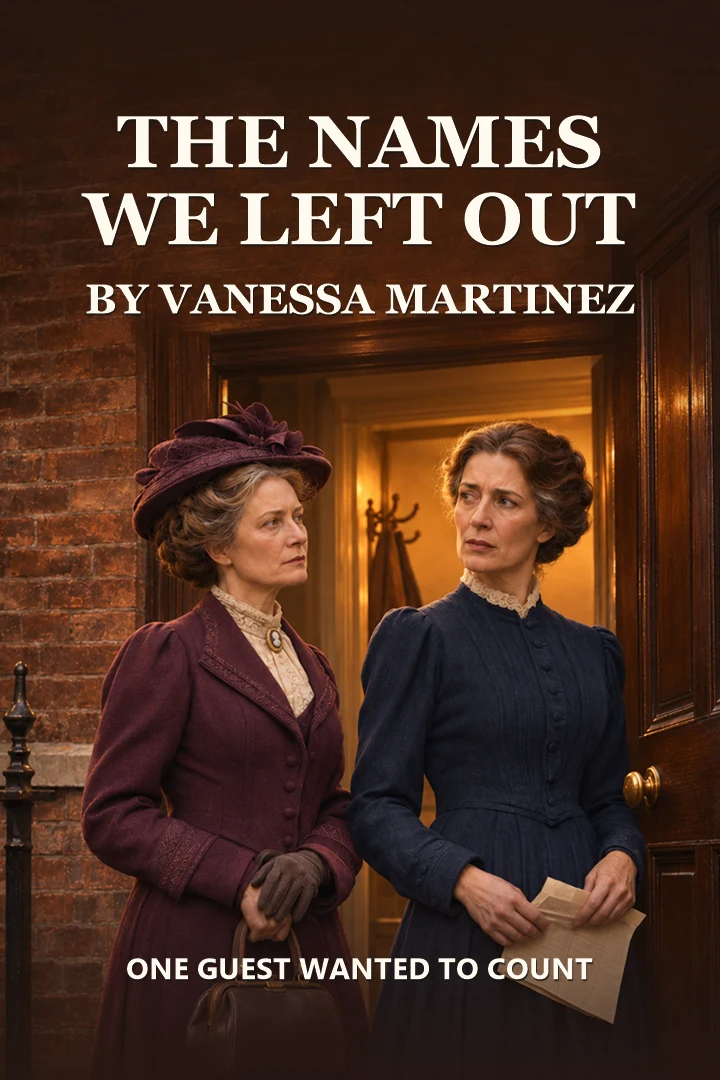
My sister arrived to disappear from the census with two travelling bags and a woman to carry them.
I had the door open before Ada could ring a second time. Rain shone on her plum-coloured shoulders; behind her, Bessie Ward stood with one bag braced against each knee. Six women were expected that evening. I had moved the good blankets upstairs and stretched the soup with another onion. Ada had promised that nobody would expect anything of me.
“Bessie will be a great help,” she said, stepping over the threshold. “We shall scarcely know she’s here.”
Bessie looked at me then, directly enough to make an introduction unnecessary. Her right glove had split across the thumb. I took the heavier bag from her and set it inside my own door. “Will you be staying because you wish to, Miss Ward, or because my sister has brought your luggage?”
Ada turned. The feather in her hat trembled with a small, indignant life of its own.
“Eleanor, don’t be difficult before we’ve taken our things off.”
“Only an ordinary question.”
“I understood we were coming for supper,” Bessie said.
The rain tapped the glass above the door. Behind us the dinner bell, which Mr Harcourt had taken to ringing when he considered I had overlooked the hour, gave a single complaining note.
“Supper,” Ada repeated, as if the word had been an unfortunate mistake made by the English language. “And the arrangements.”
“For tomorrow.”
“Naturally.”
Bessie bent to pick up the second bag. I put my foot beside its handle.
“Have you brought something for the night?”
“No, Mrs Bellamy.”
Ada’s face changed, but only a little. A tiredness appeared beneath the powder. She had come down from Hampstead after an afternoon meeting and had expected to be welcomed; here was her younger sister demanding an account of a journey before offering a cup of tea. I knew exactly how I looked to her. For a moment I saw myself as well: a widow of forty-seven in an old blue dress, standing guard over a bag because there was nothing grander available to guard.
I moved my foot.
“Go and warm yourself in the dining room, Miss Ward. We shall manage about tomorrow when tomorrow comes.”
“Bessie, please,” she said. She looked at Ada before she said it, as though the permission might belong elsewhere. “If it suits.”
“It suits. Eleanor.”
“No one will remember which of us they want,” Ada said.
“They generally find a way.”
I took my sister’s hat. She winced when she drew her fingers out of her gloves; the knuckles were swollen again. The heavy bags were not an invented difficulty, though she need not have packed as if we were closing the Channel behind her. I hung her coat where it would drip on the tray, not on the carpet, and heard my mother’s voice in the instruction I gave her. At fifty I supposed Ada would still turn me into a girl of seven by putting a wet thing in the wrong place.
Mr Harcourt was standing beside his chair when we entered the dining room. He had one of the two English newspapers he bought daily folded over a forefinger, and his expression suggested that he had found something culpable in both of them.
“Mrs Bellamy, I wonder whether I might speak to you before the arrival of your other guests.”
“If it’s about the fire, I am having it made up.”
“It is about the character of the house.”
Ada stopped rubbing her hands. It had been a long walk from the omnibus, but at those words she became rather splendid.
“I’m Eleanor’s sister,” she said. “Mrs Fenwick.”
“I am aware.”
“Then you know something of the character of her guests.”
“Precisely.”
I put her hat on the sideboard. It slid a little, the feather pointing at a cold potato left from luncheon, and the entire confrontation became less majestic.
“Mr Harcourt has the front room on the first floor,” I told her. “He teaches. He is particular about quiet after ten.”
“So am I.”
That was untrue. Ada liked best to talk at eleven, when the rest of the world had grown sufficiently discouraged to stop interrupting her.
He opened his newspaper, showed me a paragraph about the census boycott, and laid it beside his plate. “I chose this address for its tranquillity. I cannot have persons shouting in the passage.”
“No one is going to shout in your passage,” Ada said.
“It is Mrs Bellamy’s passage,” I said, with more force than either remark required. “And I have let rooms for two nights. There will be supper at seven, breakfast at eight, and I shall ask everyone to be considerate, as I ask you.”
His eyes went to Ada. Her husband had paid for her coat, and my husband was dead. Neither circumstance could be discerned in our manners, but Mr Harcourt made a small adjustment all the same.
“I hope there will be no unpleasantness.”
“Then let’s begin by having none.”
I said it cheerfully, to make it possible for him to smile. He did not. Bessie, standing behind my sister, pressed her lips together.
The dining-room door opened and Nell appeared carrying the tray of clean glasses against her hip. She had a pencil behind her ear, which she had borrowed from Mr Leach before he left for Birmingham and would probably keep until he remembered it. My daughter had a way with pencils. She could make a poor one last for months, turning it, sharpening only one side, and putting it down where her hand would find it without a search.
She set the tray on the sideboard and kissed Ada.
“We’ve put you in my room. I’ll take the little bed in Mother’s.”
“Oh, my dear, you needn’t have.”
“There isn’t anywhere else.”
I wished she would learn to accept a polite fiction when it was put before her. I also wished Ada had not said it.
“Arthur’s coming after supper,” Nell added. “I told Mother yesterday.”
“Yes,” I said. “I remember.”
She looked at me just long enough for us both to know that I had not.
We had been expecting six women since Wednesday. On Thursday Ada wrote that one of them might bring a friend, and on Friday that the friend had been unable to come but that I should not be surprised if Mrs Price arrived with a parcel of literature. I had spent Saturday taking the front sitting room apart. Four upright chairs from upstairs now stood beside the sofa. The table Thomas and I had bought when Nell was a baby had gone against the wall. Under it were two bundles of pamphlets Ada had sent by carrier, each wrapped so stoutly that one might have supposed a modest collection of treason to be glassware.
The women were to sleep where they could be fitted. Mrs Wetherby and Mrs Price would have the usually unlet back room, Miss Shaw and Miss Benton the two narrow beds Nell and I had once shared during the week the kitchen ceiling fell. Ada would have Nell’s bed. The youngest woman, Miss Ellis, had agreed to a folding bed in the sitting room. I had agreed to everything else. It was the sort of arithmetic at which I excelled: six women and six beds, provided two other women made themselves smaller.
In the kitchen Nell set a saucepan over the flame and lifted the lid from the soup.
“There are seven.”
“Miss Ward hadn’t understood about the night.”
“Neither had I, about giving up tomorrow afternoon.”
I reached for the bread knife. “You’ll be out with Arthur.”
“We were going to ask you to come.”
“Then another Sunday.”
She took the knife from me and began cutting. “That’s what I said to him.”
I had meant the visit as a kindness to Ada. My sister could not be expected to wander the streets all night with her wrists, and though I had little understanding of the census protest I understood the refusal to write things down for someone who would not listen when you spoke. I had spent most of my marriage giving Thomas figures for the household which he received as a request for extra money rather than an account of what his existing money could buy. He had been a good man. One must be allowed to remember that a good man could be tiresome without having the kindness of his life brought forward in defence.
Ada’s letter had offered ten shillings a woman for the two nights, with meals. Three pounds. I had calculated the food twice, the coal once, and the washing not at all because I would do it myself. It would leave something after expenses. We needed something. A cracked bedroom basin, which Mr Leach had apologised for and somehow not paid for, sat under the scullery bench. The quarter’s rent had left the cash tin with a thin, foolish look.
“You will ask for the money tonight?” Nell said.
“Ada knows.”
“Yes. But will you ask?”
I had reason to dislike the question, which did not make it an unreasonable one.
“I’ll attend to it.”
Nell cut one thick slice off the loaf and put it on a separate plate. “For Miss Ward. She looks as though she’s been carrying that bag since Wednesday.”
By seven the hall smelled of damp wool and Ada’s lavender water. Mrs Wetherby came first, a tall woman with a white fringe and boots substantial enough to survive the downfall of a government. She asked to see the kitchen before her room, said the soup smelled excellent, and gave me a paper parcel of tea. Miss Shaw arrived next, explaining that she was Dora when her shoes pinched and Miss Shaw only in the office; Miss Benton followed carrying a roll of drawings she would not leave at home because her brother had once used a watercolour to cover a birdcage. Louisa Price had indeed brought literature, which she handed to Ada as if surrendering a sick infant. Ruth Ellis came last and apologised before anyone had said a word to her.
“Have I missed something?”
“Only me asking for payment,” I said.
Nell, coming up the stairs, stopped. Ada glanced at the open dining-room door.
“Of course, darling. I was going to speak to you privately.”
I could have had her gratitude or her money. I would almost certainly not be able to have both in the same instant.
“Three pounds, as we arranged.”
She took a small purse from her bag, then a smaller one from that. There were cards, a folded note, and a button. At last she produced three sovereigns and laid them in my palm.
The coins were warm. It embarrassed me that their warmth should make me feel affectionate towards her again.
“There,” she said. “Now you mustn’t let us trouble you.”
I put the coins in my pocket. “Nell will show you upstairs. We’ll eat in ten minutes.”
That was the first decision of the evening I had made without leaving an opening for anybody else’s comfort.
At supper Mrs Wetherby sat beside Mr Harcourt and asked whether he taught arithmetic. When he said Latin and English, she looked disappointed and began discussing a translation. Within five minutes he was leaning towards her across the cruet. Ada had expected him to be difficult; I could see her feeling cheated.
Bessie took the plate Nell had set for her and moved towards the kitchen door.
“There’s a chair here,” I said.
“I’ll help with the serving.”
“You can pass the potatoes from here.”
I had not enough matching glasses for the table. Bessie used the thin one Thomas had bought for the birth of a neighbour’s baby, a baby now in a warehouse somewhere and larger than her father. She noticed the shallow crack in the stem and turned it away from her fingers. It was such a practised movement that I wondered how many houses she had eaten in where one waited for the glass to break before replacing it.
There was talk of the afternoon’s meeting. Ada had stood near the back, unable to hear portions of the speeches, and was now admirably certain what had been said. Dora described a man who had come to argue and remained to borrow a pencil. Ruth listened with her hands folded in her lap. She worked in a shop where the owner disapproved of women discussing politics within reach of customers.
“Then we must be particularly careful about your name,” Ada said. “Not a word of it on any schedule.”
Ruth lifted her head. “I haven’t quite decided.”
“But my dear, that’s why you’ve come.”
The conversation around the translation had stopped. Mr Harcourt looked down the table; he had acquired the delighted gravity of a man who need not provoke the argument he intended to enjoy.
“I came because you said there’d be other girls,” Ruth replied. “Women. I wanted to hear.”
“And so you shall.” Ada gave her a generous smile. “Nobody is going to compel you.”
“It is a requirement, actually,” Mr Harcourt said. “Of the law.”
“I meant to protest.”
“Very well, then.” He broke a potato with his fork. “Perhaps you should be precise.”
I wished I had not served him first.
Ada turned to Bessie. “We’ll have plenty to do tomorrow. Would you bring the second bundle down after we’ve eaten? Then we can make up the packets while Eleanor clears.”
“I have to go home,” Bessie said.
Ada’s fork remained above her plate. “We have the back sitting-room sofa.”
“At my lodging. I told Mrs Webb I would be back.”
“But there is the question of your name, too.”
“I know what my name is.”
No one laughed. A lightness entered her face and disappeared almost at once, as if she had hoped we might make it a joke for her.
“I meant whether you would be recorded,” Ada said.
“I haven’t spoken to you about that.”
“There has hardly been time.”
Bessie put her fork down. “Five weeks.”
The little phrase took the whole table. Even Nell, carrying the gravy boat, stopped beside the sideboard.
Ada’s colour rose slowly, first at the throat, then along the line of her cheek.
“That is a separate matter.”
“It keeps turning out to be,” Bessie said.
I remembered the three sovereigns in my pocket. Until that moment I had been glad of their reassuring weight. Now I could feel the shape of each coin through the cloth.
I had let Ada six beds. Before morning I would have to discover what else she believed she had bought.